The Ontology of Splicing and Metastasis
Lee Sun-young (Art Critic)
While Lee Seung-hyun employs drawing as his primary medium, he functions less as a traditional painter and more like a peculiar scientist immersed in "cryptozoology"—the study of unknown creatures. His works, presented as a fantastic bestiary where various species are grafted together, frequently transcend the formal boundaries of established art. In his world, splicing and metastasis occur in multi-dimensional directions. Beyond mere morphological combinations, his creations are interconnected at a cellular level; when the folded surfaces of his enigmatic printed images are unfurled, they reveal a structure that proliferates into yet another plane of connection. Even when a frame exists, the screen of a fixed size forms a sort of module, connecting seamlessly without a designated top or bottom. A prime example is his work consisting of dozens of panels attached to a wall, which can be rotated to connect in any direction. Once the connection points are set, both the internal modules and their final network can expand freely into "unknown continents." This infinite number of possibilities gives birth to calculated yet unpredictable lines of connection.
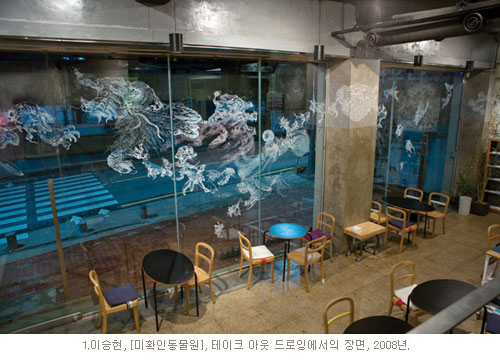
However, Lee’s work exerts its true power within actual physical space rather than in modular abstract domains. His 2008 drawing installation at Takeout Drawing in Seongbuk-dong is a prime example of applying "cryptozoology" to "The unidentified zoological gardens." Here, cryptozoology was manifested within real spaces—windows, stairs, interior walls, and pillars—where the exhibition period doubled as the production and proliferation period. Without a clear starting point or a fixed direction, these unknown organisms blanketed the space. While they adapted to the site’s architecture, they remained unconstrained by gravity or formal frames. The work was not a mere transcription of images from the artist’s mind but progressed through an interactive relationship with the surroundings. Stains on the exposed concrete walls became seeds for images, and the proliferated images, in turn, formed a cyclical structure that transformed the space itself. These site-specific works created organisms that seemed as though they had inhabited the location for ages. Furthermore, rather than being monumental fixtures like traditional murals, they exist only as archival records, much like legendary beasts. These unknown creatures, multiplied within the space, breathe in a realm overlapped with the humans moving within it.
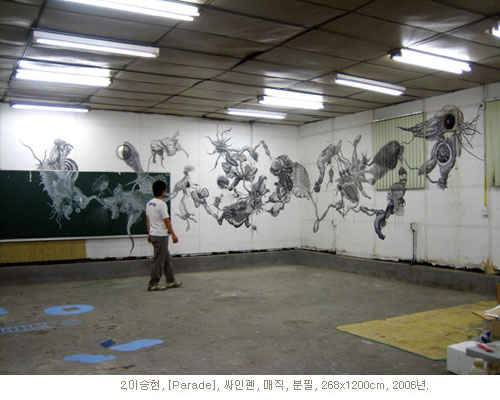
These unknown organisms proliferate not only in sophisticated modern spaces but also in transient sites like temporary structures slated for demolition. The work [Parade] (2006), drawn on a prefabricated temporary building scheduled for removal, fully utilized the wall's structure and existing objects. Unknown creatures dwelled in or passed through chalkboards, blinds, power cords, and ventilators. Discarded or broken machinery became part of their internal organs. Depending on the nature of the surfaces encountered, chalk, felt-tip pens, and markers were used to penetrate the situation appropriately. These unknown life forms do not reside in primeval Earth, unpolluted sanctuaries, or far-off space; they dwell within our surrounding objects, machines, and spaces. They infiltrate the specific environment they encounter, undergoing mutual transformation.
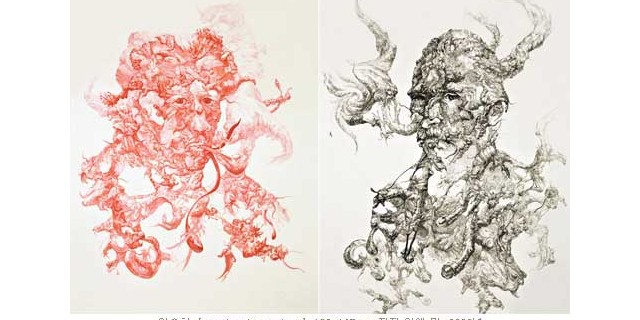
This will to transform spares no existing work of art. The [Masterpiece Virus] series, which infiltrates classical icons of Western art history with virus-like foreign substances, is an example of this desire to escape regulation and framing. Works like Laocoön, Mona Lisa, The Last Supper, Olympia, The Gleaners, Guernica, and Van Gogh’s Self-Portrait have all fallen victim to this infiltration. While this process loosens the invisible power structures that define "masterpieces," a closer look at the works Lee focuses on suggests he might be restoring their inherent "heterogeneity." Landmark works often possess a mutant-like existence that diverges from sequential order, yet they are transformed into clichés through the frames of history and logic—such as art history and aesthetics—and, above all, through institutional apparatuses and popular mythologization. Thus, in this context, deconstruction becomes construction. This process of heterogenization is also carried out through form; while the content is Western art history, the format follows traditional Eastern painting, using ink or red ink on jangji (traditional Korean paper). With backgrounds omitted, typical parts of the masterpieces remaining in consciousness are transformed into monochromatic, indeterminate images with delicately rendered tonal gradations. These sequences of lines, drawn as the body and mind dictate, are products of automatism without preliminary sketches. This production process, where even the artist cannot predict the outcome, maximizes the playfulness and immersion of the work. Unwilling to let his work solidify into a single style, the artist seeks to open his practice to the unknown and to contingency. Of course, the sheer volume of his work has inevitably led to certain practiced methods; the detailed lines forming the unidentified animals sometimes take on a rhythmic flow.
Lee Seung-hyun’s work is not merely a product of the unconscious. The space where his unknown organisms emerge and inhabit is the realm between consciousness and the unconscious. Furthermore, these life forms are both primal and futuristic, with the two being mutually interchangeable. This relates to the fact that the monster is a being on the "border." Monsters linger in the zones of metastasis and mutation. As the animality writhing within us, the monster simultaneously evokes imagination and horror. This ambivalence has been a subject of interest in psychology and religious studies. In Strangers, Gods, and Monsters, Richard Kearney points out that, as in psychology, the simultaneous occurrence of imagination and horror in religious studies represents the experience of "the uncanny" (das Unheimliche). The theologian Rudolf Otto interpreted the uncanny as a signal of transcendental holiness, describing it as a "strange, mysterious experience of an absolutely different world breaking into our familiar one."
In contrast, Freud offers no transcendence. He identifies it merely as the trace of repressed unconscious trauma. According to Freud, the "uncanny" encounter with the monstrous is not an encounter with an absolute Other, but rather the revelation of the "repressed Other" within our own ego. Lee Seung-hyun’s "cryptozoology" oscillates between a macroscopic mythological-religious dimension and an intimate psychological one. The reality governed by reason simultaneously provides a fantastic reservoir where madness emerges. Since Romanticism, and particularly in the post-modern era, the generation of alterity through cross-breeding has become frequent in art and subculture. This is linked to the problem of perceiving reality and identity. The unknown life forms in Lee’s work deal not with a fixed reality or identity, but with a variable one. They are complex beings, composed of diverse elements, flexibly merging with the Other. These mutant-like entities capture and enrich the reality surrounding them. They constitute a subject-reality complex and implement a plural exchange. In Chaosmosis, Félix Guattari argues that a complex of subjects thus formed is not a pre-existing subjectivity but proceeds toward new creation, producing "grafts of metastasis" that relate to an aesthetic paradigm. These unknown creatures demonstrate the diverse facets of subjectivity in its nascent state and the artistic, creative nature of the production of the subject.
These amorphous organisms move in close contact with the surface, much like two-dimensional life forms. By erasing the objective dimension, the reality encountered by these creatures appears contingent. [Parade], created in a temporary structure, responds to the arrangement of real objects that appear heterogeneous at every moment through splicing and metastasis. Monsters seem to escape through dusty vents, passing through chalkboards, temporary walls, and blinds. The Other, the backside of the subject, thus traverses and flees reality. Here, the subject supported by reason and reality becomes simultaneously estranged.
The Others, who have escaped homogenization through an uncontrollable force, establish their own temporary "liberated zones." Drawing installations in cafes or temporary structures are not permanently preserved but live their short yet intense lives. These "Other" entities do not aim for a clear essence but for a temporary process, prioritizing excess and surplus over moderation, thereby exposing the uncanniness and strangeness inherent in the subject and reality. Lee Seung-hyun’s works, which can be called landscapes of the unconscious, feature unknown organisms that colonize and traverse surfaces, thereby dismantling conventional thoughts about the unconscious as something primal drawn from the depths. They are not only primitive but also interface with machines, internalizing them and mutually transforming them. In The Machinic Unconscious, Félix Guattari asserted the existence of an unconscious that is generated within specific arrangements of reality and traverses its various layers, as opposed to an unconscious with a deep structure or origin. Here, consciousness is not reduced to an unconscious origin but operates by constantly transforming into something else.
It does not take the form of a deep abyss but rather a rhizome where surface orders interact. Guattari believed that the unconscious is not an invisible, inaudible presence in the abyss, but something that moves in attachment to our bodies and social relations in our daily lives. This connects to the idea that the unconscious is not merely a place of repression or symbols, but a material for creating something new. Here, the unconscious is newly constructed and invented, moving beyond passive symptoms or representations. Unknown creatures are chaotic because they are in the midst of metamorphosis, a transformation intended to traverse and escape reality. The concepts of transversal and lines of flight (escape) are "Otherly" practices that collapse the boundaries of the self. They generate heterogeneity against a universal order that reproduces the homogeneous. Chaosmosis defines the process of continuously becoming something else as heterogenesis. If the consciousness that dominates reality is homogenesis, the way the unconscious operates is heterogenetic.
Unknown organisms that become something else through subtle flows move toward heterogeneity rather than consistency of existence. They do not simply scatter; they flow in various directions and form new arrangements. Here, as Guattari points out, the unconscious becomes a site of all possibilities for connection in every domain. It does not recognize a dominant, decisive layer that follows a single causality. If creatures in nature that simply reproduce themselves, or the capitalistic order that codifies everything for profit, are homogenetic, then organisms in the midst of contingency and chaos are heterogenetic. However, contingency and chaos alone are not enough for a movement toward the unknown. It requires "Chaosmosis"—the mutual infiltration (osmose) of chaos and order (cosmos). The appropriate category to explain these complex entities is not logos or structure, but the machine. A machine, a collection of interactions between components, stands at the crossroads of finitude and infinitude, at the negotiation point between complexity and chaos. The ideal machinism that can realize chaosmosis is not a mechanism that is cut off from the outside and reproduces only repetitive codes, but one that connects and operates for new possibilities.
It focuses on processual openness. The unknown creatures created by Lee Seung-hyun are neither abstract nor concrete. They are singularities that exist within a certain situation, but they do not belong to the category of particularity that mediates between the abstract and the concrete. These singularities are swayed by neither contingency nor structure. Chaosmosis, which will serve as an alternative paradigm to the erroneous custom of subordinating and reducing everything to a single order, emphasizes the arrangement (assemblage) that produces new flows. An arrangement is, above all, "a mapping of possibilities and virtualities as much as of constituted elements, without considering any genus or species relationship" (Guattari). The arrangement shown by Lee Seung-hyun’s unknown creatures, which delve into the various curved surfaces of reality, cannot be reduced to contingency or universal axioms. If there is a law that governs the arrangement, it is only the movement of the line of flight. The impulse to violently deconstruct fixed categories is coupled with the directionality of escape. Through this coupling, existence can overcome the situation of being either subordinated to a structural order or dissolved into the contingent.
Nanji Residency 3rd Term: Artist-Critic Matching Program
접합과 전이의 존재론
이선영(미술평론가)
이승현은 드로잉을 주된 표현수단으로 삼고 있지만, 전형적인 화가라기 보다는 미지의 생물을 탐구하는 괴상한 과학자처럼 ‘미확인 동물학cryptozoology’에 몰두한다. 여러 종의 부분들이 접합된 환상적인 동물지로서 그의 작품은 틀을 갖춘 미술의 형식을 넘어서곤 한다. 접합과 전이는 다차원적 방향을 가진다. 외형상의 조합을 넘어 세포적 차원에서도 상호 연결되어 있는데, 불가사의한 이미지들이 인쇄된 접지 면을 펼치면 또 다른 연결 면으로 증식되는 구조를 보여주곤 한다. 프레임이 있는 경우에도, 일정한 크기의 화면이 일종의 모듈을 형성하면서 위아래가 따로 없이 연결된다. 벽에 붙은 수십 개의 패널의 방향을 돌려 사방으로 연결될 수 있는 작품이 그것이다. 접속 부위만 설정하면 모듈 내부도, 모듈들의 최종적인 그물망도 미지의 대륙으로 자유롭게 뻗어나갈 수 있다. 무한한 경우의 수는 계산과 예측 불가능한 연결선을 낳는다.
그러나 이승현의 작품은 모듈적인 추상적 공간보다는 실제 공간 속에서 더 힘을 발휘한다. 2008년 성북동의 테이크아웃 드로잉에서 진행한 드로잉 설치작업은 ‘미확인 동물학’을 ‘미확인 동물원’으로 적용시킨 예이다. 그것은 미확인 동물학을 유리창, 계단, 내벽, 기둥 등의 실제 공간 속에서 구현한 것으로, 전시 기간이 동시에 작업기간이고 증식기간이다. 시작점이 분명치 않고 방향도 정해지지 않은 채 미지의 생물체들은 공간을 뒤덮는다. 장소의 구조에 적응하지만, 중력이나 틀에 제한받지 않는다. 작업은 작가의 머릿속 이미지를 그대로 옮기는 것이 아니라, 주변과 상호작용적으로 진행된다. 노출 콘크리트로 된 건물 벽의 얼룩들은 이미지의 씨앗이 되고, 증식된 이미지는 공간을 변형시키는 순환적 구조를 가진다. 장소와 밀착된 작업은 오랫동안 그곳에서 서식했던 것 같은 생물들을 창조했다. 또한 그것은 벽화처럼 영원한 기념비적 존재가 아니라, 전설상의 동물처럼 자료로만 남는다. 공간에 증식된 미지의 생물들은 공간 안에서 움직이는 인간들과 중첩된 공간에서 숨 쉰다.
세련된 현대적 공간 뿐 아니라, 곧 철거될 가건물 같은 장소에도 미지의 생물체가 증식된다. 철거 예정지인 조립식 가건물 위에 드로잉 한 작품 [parade](2006년)는 벽면의 구조와 사물을 최대한 활용했다. 칠판, 블라인드, 코드선, 환풍기 등은 미지의 생물체가 머무르거나 지나간다. 버려지거나 고장 난 기계는 기관의 일부가 된다. 만나는 평면들의 성질에 따라 분필, 싸인 펜, 매직 등이 활용되면서, 상황 속으로 적절하게 파고든다. 미지의 생물체는 원시의 지구나 오염되지 않은 장소, 머나먼 우주에 서식하는 것이 아니라, 우리 주변의 사물, 기계, 공간 속에 거주한다. 자신이 맞딱뜨린 구체적 환경 내부로 침투하여 서로 변형되는 것이다. 변형에의 의지는 기존 예술작품도 예외가 될 수 없다. 명화로 알려진 서양미술사의 고전들에 바이러스같은 이물질을 침투시킨 [masterpiece virus] 시리즈는 규정되고 틀지어진 것을 벗어나고자 하는 의지가 미술작품에도 적용된 예이다. 라오콘, 모나리자, 최후의 만찬, 올랭피아, 이삭줍기, 게르니카, 반 고흐의 초상 등이 희생되었다.
그것은 명화를 규정하는 보이지 않는 권력들을 느슨하게 하는 작업이지만, 이승현이 주목한 작품들의 면면을 보면, 그것이 지닌 본래적 이질성을 되돌려 준 것은 아닌가하는 생각이 든다. 시대의 획을 긋는 작품들은 연속적 질서로부터 이탈된 돌연변이 같은 존재태를 가지는데, 미술사나 미학 같은 역사와 논리의 틀로서, 무엇보다도 제도적인 기구들과 대중적인 신화화를 통해서 상투적인 것으로 변모하기 때문이다. 그렇다면 여기에서 해체는 구축이 된다. 이질화 작업은 형식을 통해서도 관철되는데, 내용은 서양 미술사이지만 형식은 동양화처럼 장지 위에 먹이나 홍 먹으로 그린다. 배경은 생략된 채 의식에 남아있는 명화의 전형적인 부분이 명암의 계조가 섬세하게 살려진 단색조의 불확정적인 이미지로 변형된다. 몸과 마음이 가는대로 그려지는 선의 계열들은 사전스케치 없는 자동기술의 산물이다. 그리는 당사자도 결과를 예측할 수 없는 제작과정은 작업의 유희성과 몰입을 극대화 한다. 작품이 어떤 하나의 스타일로 고착화되기를 바라지 않는 작가는 작업을 미지의 것과 우연성에 개방시키려 한다. 물론 쌓여진 작업량만큼 손에 익은 방식들이 나올 수 있다. 미확인 동물들을 이루는 세부의 선들을 일련의 리듬을 타기도 한다.
작업은 단지 무의식의 산물만은 아니라는 것이 이승현에게도 해당된다. 그가 풀어놓은 미지의 생물체들이 발생하고 서식하는 곳은 의식과 무의식 사이의 공간이다. 또한 미지의 생물체는 원초적일 뿐 아니라 미래적이다. 양자는 상호호환적이다. 그것은 괴물이 경계 위의 존재라는 점과 관련 된다. 괴물들은 전이와 변이의 지대에서 서성거린다. 우리 내부에서 꿈틀거리는 동물성으로서의 괴물은 상상과 공포를 동시에 발생시킨다. 이러한 양면 감정은 심리학과 종교학의 관심 대상이었다. 리처드 커니는 [이방인, 신, 괴물]에서 심리학에서 그랬던 것처럼 종교학에서 상상력과 공포의 동시발생은 ‘기묘한 낯설음das Unheimliche’의 체험을 나타낸다고 지적한다. 종교학자 오토는 기괴함을 초월적 신령함의 신호로 해석하여 ‘절대적으로 다른 세계로부터 우리의 친숙한 세계로 난입해 들어오는 낯선 신비체험’이라고 한다.
이와 대조적으로 프로이트는 어떤 초월성도 제시하지 않는다. 단지 억압된 무의식적 트라우마의 자취로서 그것을 파악한다. ‘괴물스러운 것들과 마주치는 기묘한 낯설음은 절대적 타자가 아니라, 바로 우리 자아 안에 있는 억압된 타자의 드러남일 뿐이다’(프로이트) 이승현의 ‘미확인 동물학’은 거시적인 신화적 종교적 차원과 내밀한 심리적 차원을 넘나든다. 이성이 지배하는 현실의 문명은 광기가 출몰하는 환상적 저장소를 동시에 마련한다. 근대 낭만주의 이래로, 그리고 근대 이후의 시기에 와서 예술은 물론 하위문화에서도 이종교배로 인한 이질성alterity의 생성이 빈번해졌다. 그것은 현실과 정체성을 바라보는 문제와 연결된다. 이승현의 작품에 등장하는 미지의 생물체들은 고정된 현실이나 정체성이 아니라, 가변적인 현실과 정체성을 다룬다. 그것들은 그자체가 다양한 요소로 구성되어 있으며, 타자와 유연하게 결합하는 복합적인 존재들이다.
이 돌연변이같은 존재들은 자신을 둘러싼 현실을 포획하여 풍부하게 만든다. 그것은 주체-현실의 복합체를 구성하며 복수적 교환을 시행한다. 펠릭스 가타리는 [카오스모제]에서 이렇게 형성된 주체의 복합체는 이미 존재하는 주체성이 아니라, 새로운 창조로 진전하며 그 자체가 일종의 미학적 패러다임과 관련되는 전이의 접목들을 만들어 낸다고 본다. 미지의 생물체들은 발생기 상태의 주체성이 가지는 다양한 면모와 주체의 생산이 지닌 예술적이고 창조적인 성격을 보여준다. 이 무정형적인 생물체는 마치 2차원 상의 생물처럼 표면과 밀착해서 움직인다. 객관적인 차원을 삭제함으로서 생물체가 맞딱뜨리는 현실은 우연적으로 나타난다. 가건물에서 작업한 [parade]는 끊어질 듯 이어지는 접목과 전이를 통해 매 순간 이질적으로 다가오는 현실적 사물들의 배치에 반응한다. 괴물들은 칠판과 가벽과 블라인드를 거쳐서 먼지 낀 환풍구로 빠져나가는 듯하다. 주체의 이면인 타자는 그렇게 현실을 횡단하며 탈주한다. 여기에서 이성에 의해 지원받는 주체와 현실은 동시에 낯설어진다.
억제할 수 없는 힘으로 동질화를 벗어난 타자들은 순간적으로나마 자신들만의 해방구를 마련한다. 카페나 가건물 등에서 작업한 드로잉 설치들은 영구히 보존되지 않고 짧지만 강렬하게 자신의 삶을 살아간다. 이 타자적 존재들은 명확한 본질이 아니라 일시적인 과정을, 중용과 절제가 아닌 잉여와 과도함을 지향함으로서, 주체와 현실에 내재된 기묘함과 낯설음을 들추어낸다. 무의식의 풍경들이라 할 수 있는 이승현의 작품들은 표면들을 잠식하고 횡단하는 미지의 생물체들이라는 면모는, 심층으로부터 길어 올린 원초적인 무엇으로서의 무의식에 대한 통상적 사고를 무너뜨린다. 그것은 원시적일 뿐만 아니라, 기계와 접합하고 그것을 내재화하며 상호적으로 변형한다. 펠릭스 가타리는 [기계적 무의식]에서 어떤 심층구조나 기원을 가진 무의식과 구별되는, 현실의 구체적인 배치 속에서 생성되며 그것의 다양한 층위를 횡단하는 무의식의 존재를 주장한 바 있다. 여기에서 의식은 무의식적 기원으로 환원되는 것이 아니라, 끊임없이 다른 것으로 변형하면서 작동한다.
그것은 심연의 뿌리가 아니라, 표층적 질서들이 상호작용하는 뿌리줄기의 양상을 지닌다. 가타리는 무의식이 볼 수도 들을 수도 없는 심연의 존재가 아니라, 우리의 현실생활 속에서 우리의 신체와 사회관계에 붙어서 움직이는 것이라는 생각하며, 그것은 무의식이 단지 억압된 것이나 상징의 장소가 아니라, 새로운 것을 만들어가는 재료라는 생각과 연결된다. 여기에서 무의식은 수동적인 징후나 표상을 넘어 새로이 구축되며 창안된다. 미지의 생물체들은 변신의 와중에 있기 때문에 혼돈스럽고, 변신은 현실을 횡단하고 탈주하기 위한 것이다. 횡단과 탈주라는 개념은 동일자의 경계를 와해시키는 타자적 실천이다. 그것은 동질적인 것을 재생산하는 보편적 질서에 대항하여 이질적인 것을 발생시킨다. [카오스모제]는 지속적으로 다른 것으로 되어가는 과정을 이질발생heterogenesis이라고 규정한다. 현실을 지배하는 의식이 동질 발생이라면, 무의식의 작용방식은 이질 발생적이다.
미세한 흐름을 통해 다른 것으로 되어가는 미지의 생물체들은 존재의 일관성이 아닌, 이질성을 향해 움직인다. 단순히 흩어지는 것이 아니라, 다양한 방향으로 흘러가고 새로운 배치를 형성한다. 여기에서 무의식은 가타리가 지적하듯이 모든 영역에서 접속의 모든 가능성의 장소가 된다. 그것은 단일한 인과율을 따르는 지배적이고 결정적인 층위를 인정하지 않는다. 단순히 자신을 재생산하는 자연 속의 생물이나 이익을 위해 만물을 코드화하는 자본주의적 질서가 동질 발생적이라면, 우연과 혼돈 속의 생물체들은 이질 발생적이다. 그러나 미지의 향한 움직임에 우연과 혼돈만으로 충분치 않다. 그것은 혼돈chaos과 질서cosmos가 상호침투osmose된 '카오스모제'가 필요하다. 이러한 복합적인 존재를 설명하기에 적합한 범주로 로고스나 구조가 아니라, 기계이다. 구성요소들 간의 상호작용들의 집합체인 기계는 유한성과 무한성의 교차로에, 복잡성과 카오스 사이의 협상 지점에 있다. 카오스모제를 실현할 수 있는 이상적인 기계machinisme는 외부와 단절되어 반복적인 코드만을 재생하는 존재mecanisme가 아니라, 새로운 가능성을 위해 접속하고 작동한다.
그것은 과정적 열림에 초점이 맞추어진다. 이승현의 만들어낸 미지의 생물체들은 추상적이기도 구체적이지도 않다. 그것은 어떤 상황 속에서 존재하는 특이성이지만, 추상이나 구체를 매개 짓는 특수성이라는 범주에 귀속되지도 않는다. 이 특이성은 우연에도 구조에도 휘둘리지 않는다. 모든 것을 하나의 질서에 귀속시키고 환원시키는 그릇된 관습에 대한 대안의 패러다임이 될 카오스모제는 새로운 흐름들을 생산해내는 배치를 중요시한다. 배치는 무엇보다도 ‘어떠한 속 혹은 종 관계를 생각지 않는, 구성된 요소들만큼이나 가능성들과 가상적인 것들의 장의 배치’(가타리)이다. 현실의 다양한 굴곡 면을 천착하는 이승현의 미지의 생물체가 보여주는 배치는 우연성에도 보편적인 공리에도 환원되지 않는다. 배치를 일괄하는 법칙이 있다면 탈주의 움직임일 뿐이다. 고정된 범주를 극렬하게 해체하려는 충동은 탈주라는 지향성과 맞물린다. 이러한 맞물림을 통해서 존재는 구조적 질서에의 복속이나 우연적인 것으로 해소되는 상황을 극복할 수 있다.
출전 : 난지 미술창작 스튜디오 3기 입주 작가 평론가 매칭 프로그램